25 Years Educational Leadership & Teaching Experience in British Independent & International Schools
TL;DR
- Online lessons can reduce the daily "panic points" that keep socially anxious children stuck in survival mode, so they can actually learn again.
- This guide is for parents witnessing school avoidance, shutdowns, physical symptoms (like nausea or tears), or constant reassurance-seeking around classmates and teachers.
- We walk through what social anxiety is doing underneath the surface, presenting a structured four-part plan: stabilise, rebuild confidence, practise exposure safely, and widen connection.
- Success looks like a child who can attend consistently, participate in small steps, and gradually re-enter wider social and academic life without family mornings becoming a battlefield.
It often shows up in tiny moments: a message from your child from the school toilet saying they feel sick, a tutor note about "not putting their hand up", or a report that says "capable, but quiet and withdrawn". On the school run you might hear, "I can’t do it today," even when nothing obvious has happened.
This article is for families weighing whether online schooling could help a socially anxious child feel safe enough to learn, without pretending the goal is to avoid people forever.
The friction parents describe
Parents usually don’t describe it as "social anxiety" at first. They talk about constant anticipatory dread, sensory overload, and fear of being judged: they can’t cope with timers, transitions, busy corridors, or the feeling of being watched. Many families also worry that moving online will "make isolation worse" or remove everyday friendship time, even if school is currently causing daily distress.
What is actually going on
Social anxiety is not simply shyness; it’s a fear-based loop where the brain overestimates social threat (embarrassment, judgement, rejection) and underestimates coping ability. That can trigger physical symptoms (nausea, shaking, racing heart), which then become "proof" to the child that something is wrong, so avoidance and safety behaviours (not speaking, hiding off-camera, skipping class, asking to go home) reduce anxiety short-term but strengthen it long-term. Evidence-based treatments (particularly cognitive behavioural approaches) target this loop through skills and gradual exposure, rather than pushing a child into overwhelming situations; NICE guidance recommends CBT as a first-line intervention for social anxiety disorder, tailored to age and needs. Ofsted’s recent work on children’s mental health also reinforces that anxiety and unmet needs can directly affect attendance and learning, and that schools should take a whole-school approach to wellbeing.
The four parts of the fix
1) Stabilise the nervous system (before you ask for bravery)
Rule: "Regulation first; progress second."
- What to do:
- Reduce avoidable daily stressors (commute, chaotic transitions, unpredictable breaktimes) so your child isn’t starting the day already depleted.
- Agree a simple "attendance baseline" your child can meet consistently (for example: log in, camera on if possible, stay for the first 10 minutes, even if they don’t speak).
- Use a predictable routine: same start time, same workspace, same pre-lesson reset (water, breathing, checklist).
- Why it works:
- A calmer baseline reduces threat scanning and makes learning physically possible.
- Consistency prevents the "in/out" pattern that can intensify anxiety around returning.
- How to validate:
- Track whether mornings become measurably easier (fewer tears/messages, fewer physical symptoms, quicker settling).
2) Make participation smaller than the fear
Rule: "We scale the task, not the child’s feelings."
- What to do:
- Create a participation ladder: chat response → read one sentence → answer a closed question → share a short idea → short presentation.
- Replace "put your hand up" with structured turns (teacher calls on students with warning) and written responses when speaking feels impossible.
- Use accommodations for known triggers (for some children: no timers; clear instructions; predictable turn-taking).
- Why it works:
- Graded participation builds mastery without flooding the child with too much exposure at once.
- Alternative response modes reduce performance pressure while still keeping engagement active.
- How to validate:
- Your child moves up one rung on the ladder within a few weeks (even if slowly), without a spike in avoidance.
Example participation ladder (adjust to your child):
| Step | What it looks like in a lesson | What you’re practising | Signs it’s the right level |
|---|---|---|---|
| 1 | React with an emoji / “yes” in chat | Being seen in a low-risk way | Mild nerves, still stays in lesson |
| 2 | Type one sentence answer | Accuracy without spotlight | Less rumination afterwards |
| 3 | Read one sentence aloud | Voice + brief attention | Anxiety rises then falls during lesson |
| 4 | Answer a closed question verbally | Spontaneous speaking | Can recover quickly if they stumble |
| 5 | Share an opinion (30 seconds) | Social evaluation tolerance | More pride than dread afterwards |
3) Practise exposure in a controlled, compassionate way
Rule: "Avoidance shrinks life; planned exposure expands it."
- What to do:
- Plan exposures that are specific and repeatable (e.g., “say hello at the start”, “ask one question per week”).
- Repeat the same exposure until anxiety drops, then increase difficulty slightly.
- If your child is working with a clinician, match school participation goals with therapy targets (so everyone is pulling in the same direction).
- Why it works:
- Exposure changes the prediction: the child learns, “I can feel anxious and still cope.”
- Repetition is what rewires threat learning; one-off “brave moments” don’t stick as well.
- How to validate:
- Anxiety before the exposure is still present, but the recovery time shortens (less time spent spiralling afterwards).
4) Build connection without forcing “big social”
Rule: "Friendship grows from repeated, safe contact, not pressure."
- What to do:
- Prioritise small-group interaction over large, unstructured social time (clubs, group projects, guided discussions).
- Encourage interest-led communities (coding, art, languages, debating) where conversation has a purpose.
- Keep offline connection alive in manageable ways (one friend at a time, short meetups, shared activities).
- Why it works:
- Social anxiety often spikes in unstructured settings; structured interaction reduces uncertainty.
- Identity-based belonging (“people like me”) is protective, especially for teens.
- How to validate:
- Your child starts referencing peers positively (“we did a project”, “someone helped me”), not just school as a threat.
How Sophia High School handles this
Sophia High School is a full-time British Online School for ages 4–18, delivering the English National Curriculum, Pearson Edexcel IGCSEs, and International A-Levels (IALs). Lessons are 100% live and interactive (not passive video watching), with a strict maximum of 6–8 students per class to support engagement and real connection. For some socially anxious students, this can work better than being “lost” in a large classroom.
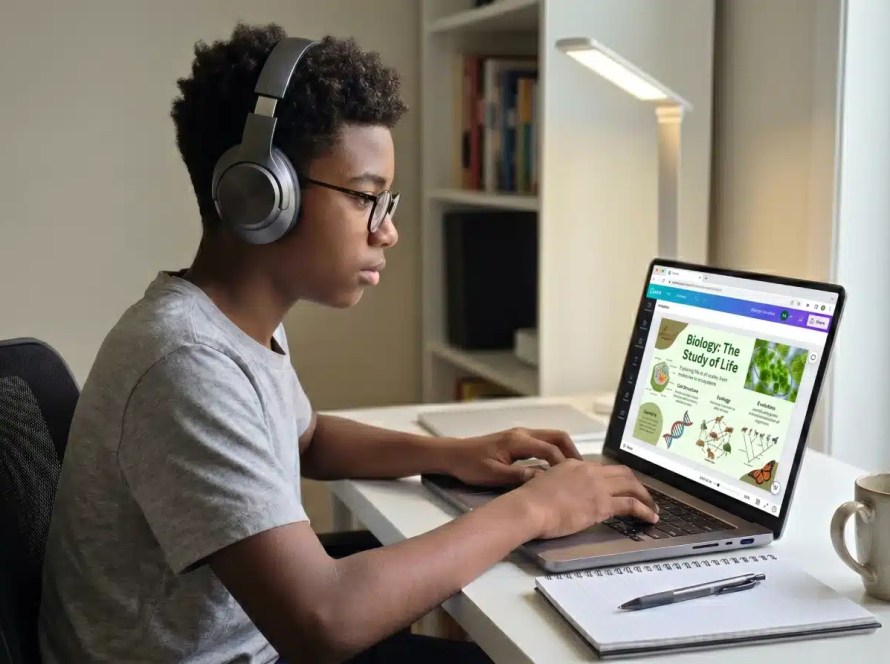
From a wellbeing standpoint, the timetable runs 8am–4pm UK time and includes daily Holistic Horizons (PSHE) plus weekly 15-minute 1-to-1 pastoral mentoring for all secondary students, which creates a predictable check-in point (important for anxious learners). For assessment and anxiety-sensitive participation, students use secure Google Classrooms alongside live CANVA digital notebooks, enabling real-time teacher feedback and allowing students to contribute in writing when speaking feels too exposed. For families worried about exams becoming an anxiety flashpoint, Sophia High School focuses on quality over quantity with a targeted 6–7 IGCSE plan, and is approved by Pearson for Remote Invigilation, allowing eligible exams to be sat securely at home.
FAQ
Q: How do I know if it’s social anxiety or just normal nerves about school?
A: Normal nerves usually settle once a child is in class; social anxiety often creates persistent distress, avoidance, and physical symptoms (like nausea) specifically linked to being seen, judged, or speaking. If anxiety is driving attendance issues or daily functioning, it’s worth discussing with your GP or a qualified clinician.
Q: Won’t online school make my child more isolated?
A: It can if it’s purely self-paced and solitary. Live, small-group lessons with consistent routines can maintain daily contact and rebuild confidence, while you add structured offline activities gradually rather than forcing overwhelming social time.
Q: My child refuses to speak in class—can they still learn online?
A: Yes, if the programme allows active participation through chat, shared documents, and structured turn-taking while building up to speaking. The goal is not to “never speak”, but to create a stepped plan where speaking becomes achievable over time.
Q: Is “cameras on” supportive or too stressful for anxious students?
A: It depends on the child, but many do better with predictable visibility than with the ambiguity of being unseen (which can increase overthinking). A good school should handle this sensitively, with pastoral support and gradual confidence-building rather than shame or punishment.
Q: What if my child panics about exams or going to an unfamiliar exam centre?
A: Exam anxiety is common, and unfamiliar settings can worsen it. Some qualifications and providers offer secure remote invigilation options; separately, practising exam routines in small steps and using approved access arrangements (where applicable) can reduce distress.
Q: Can online schooling help if my child has ASD/ADHD or sensory processing difficulties alongside anxiety?
A: Often, yes, because it can remove high-noise environments, crowding, and constant transitions that keep the nervous system overloaded. The most helpful approach is personalised support that documents triggers and practical strategies, alongside external clinical guidance where needed.
Q: Will universities take online IGCSEs and International A-Levels seriously?
A: Universities typically focus on the qualification itself and the awarding body rather than where a student sat in a classroom, but entry requirements vary by course and country. It’s sensible to check specific university and ministry requirements early, especially for competitive pathways.
Q: How can we transition back to in-person school later without undoing progress?
A: Treat it like a phased exposure plan: start with predictable, low-stakes contact (short visits, one lesson, small group), repeat until anxiety reduces, then build up. Keeping attendance consistent and involving pastoral/clinical support makes transitions more sustainable.
References
- Social anxiety disorder: recognition, assessment and treatment (NICE CG159) — UK clinical guideline recommending evidence-based approaches, including CBT, for anxiety disorders.
- Children and young people’s mental health in education (Ofsted, 2023) — Ofsted commentary and findings on mental health, attendance, and school practice.
- Keeping children safe in education (DfE) — Statutory safeguarding guidance relevant to any school model, including online provision.
- Mental health and behaviour in schools (DfE) — Practical guidance on supporting pupils whose mental health affects behaviour and attendance.
- The Good Schools Guide: Online schools — An independent overview of what quality online schooling looks like, and the questions parents should ask.
- Social anxiety disorder (social phobia), NHS — Plain-language description of symptoms and treatments.
- Cognitive therapy for social phobia: the Clark and Wells model (overview) — Summary of a leading evidence-based framework explaining maintenance factors and treatment targets.
- Pearson Edexcel: International GCSEs and International A levels — Awarding body information for Pearson academic qualifications used internationally.